


2026 Forest River R-Pod RP-197 Full RV Demonstration
See how the 2026 Forest River R-Pod RP-197 works with this complete RV demonstration from Hilltop Camper & RV.
Read the Full Video Transcript — 2026 Forest River R-Pod RP-197
2026 Forest River R-Pod RP-197 — Full Transcript
Read the complete Hilltop Camper & RV walkthrough of the 2026 Forest River R-Pod RP-197, including hitch-area equipment, battery and tire monitoring, stabilizers, water and waste systems, storage, roof and awning care, interior controls, kitchen and bathroom features, climate controls, electrical equipment, sleeping areas and everyday owner operation.
Equipment and safety note: The complete spoken transcript is preserved below. Safety/context notes are added where the video discusses equipment or procedures that can vary by RV or involve propane, batteries, towing, stabilizers, water pressure, waste systems, roof access, hot-water equipment, awnings, electrical service, climate controls or propane-fired appliances. Always verify procedures, capacities, ratings and maintenance intervals in the manuals for the exact RV and installed components.
0:19 [Music] All right. So, front of the trailer, you got a jack light here that doesn't show a lot, but you do have a light. You have up and down.
Safety note near 0:30 Propane note: This section discusses propane cylinders and an automatic changeover regulator. Propane systems vary by RV and regulator; follow the exact Forest River and component-manufacturer instructions and use qualified service if a leak or damage is suspected.
0:30 to get your hitching proper and leveling. Gas bottles are full and ready to go. So, when you turn your bottles on, I like to have them both turned on at the same time. Okay, this right here is an indicator. It's pointing this way. We were running off of this tank. Okay, tank runs empty. We can switch over and it will run off of this tank. You can go get this one
0:52 filled, but do not turn this into a convenience store because this is still under warranty. So, if there was a problem, you aren't going to get a warranty is not going to cover it because it's not the same tank. Easy way to tell how full your tanks are. Dump some warm water over the tank and it's going to show you a frost line. Um, normally you would have a 12-volt deep cycle battery here.
Safety note near 1:15 Battery note: Battery type, charging and cold-weather storage requirements vary. Follow the battery manufacturer and Forest River storage instructions for the exact installed battery.
1:15 That battery is going to run everything in the coach except for your air conditioner, microwave, and 110 outlets. All right. Winter time you want to take that out and put it someplace warm. Otherwise, it's going to freeze and crack on you. You're going to be out about $200. So, put a charge on it and you're good for the winter. Um, here we have a battery disconnect. Okay, that's going to disconnect the power from the battery to the coach. This right here, you have tire
1:40 sensors. Okay, this particular model, I believe, sends tire monitor air pressure uh caps. So, you can put those on and hook it up to your phone and go Bluetooth. Did forget about this little guy
Safety note near 1:54 Towing note: This section discusses the breakaway system. Verify the exact tow vehicle, hitch, brake-controller, trailer ratings and legal requirements before towing.
1:54 right here. This is your breakaway system. Okay. If the truck and trailer ever came apart, it would pull a pin out, lock your brakes up so the trailer doesn't go down the highway and have an accident with you or somebody else. This does not hook on to the chains. It hooks onto the receiver. So,
Safety note near 2:20 Stabilizer/leveling note: Stabilizers are intended to reduce movement after the trailer is level, not to lift or level the trailer unless the manufacturer specifically permits it. Follow the exact jack and Forest River instructions.
2:20 we'll come around this side of the trailer. All four corners have jacks. These are meant to be brought down and snugged up. they're not to be leveling the trailer. You're level the trailer with your front jack front to back and then either pads or planks to side to side. Okay. Inside here, you got a pass through uh storage that there's your power cord, your griddle, that type of stuff.
2:46 Behind that spare tire is going to be your freshwater fill. That would be the top one.
Safety note near 2:53 Water-pressure note: Campground water pressure varies. Use the RV/plumbing manufacturer guidance for acceptable pressure and compatible regulators.
2:53 The bottom one is going to be your city water connection. Okay. No more than 60 pounds of water pressure going into these campers. They do make a water regulator that regulates your water at 45 to 50 lbs. I would recommend that highly. Yeah. The furnace that that's the vent for the
Safety note near 3:09 Furnace-exhaust note: Exterior furnace components can become hot during operation. Keep combustibles clear and follow the furnace manufacturer’s clearance and service instructions.
3:09 furnace right there that gets very hot. So, we want to lean anything up against it, touch it, what have you. It will burn. Coming this way towards the rear of the camper. That there is your uh cable satellite hookup. And then coming back farther, this is where your power cord
Safety note near 3:22 Shore-power note: This section identifies the RV’s 30-amp power connection. Use properly rated, undamaged equipment and follow campground-pedestal and Forest River electrical instructions.
3:22 is going to plug into. Okay, that's a 30 amp service. The light is a motion light. So, anytime somebody walks past that, that light is going to come on. So, uh this way here, um you do have capability of storing your sewer hose in the bumper, but if you have the 90° elbow on it, we're going to have to take that off and put that somewhere else. But you can fit two 10-footers in
3:46 the in the bumper. um your sewer system. You got a black handle and a gray handle. The the black
Safety note near 3:53 Waste-system note: This section discusses sewer connections and black-/gray-tank draining. Follow the RV sanitation-system instructions, campground rules and appropriate protective practices.
3:53 one is the 3-inch valve. We're going to pull that one first, and that's going to dump your toilet, and then we're going to dump the gray, which is going to clean out your tube. Um if you are camping someplace that has um sewer at the site, you can run your hose out, but make sure your valves are closed because one of two things, if the black water, all the water's
4:15 going to run out and everything else is going to stay in the tank. And another thing is you're going to end up taking sewer gas. And how these valves work is when you pull it, it's a suction that brings all the sewer out or all the waste out. And then your low water points should be
4:38 somewhere right here. Oh, there we go. So the things we want to do for this job, Steve. Yeah. Now, can you help me up? I can't. I can't get up. We'll be right back, ladies and gentlemen. Right. So, here you have um the housing for your out your backup camera or security camera,
5:04 however you want to do it. We do sell a couple different brands. This is a lip ladder. It come This does not come with the camper. It just comes with the mount. Okay. The ladder is a
Safety note near 5:15 Roof-access note: This section discusses roof inspection and cleaning. Roof access can involve a fall hazard; follow Forest River’s approved inspection method or use qualified RV service.
5:15 collapsible ladder. comes down to about right here. Very handy to have. Okay. Because I want you up on that roof at least twice a year making sure your seals are all good and not cracked. So, we want to maintenance is a big thing. You had some good advice on uh when you're actually up there. Maybe not just walking on that roof. We is what you know I like I said I I like to go
5:38 hands and knees, but is what I'm looking at is cracks in my ceiling, cracks in my vents, that type of stuff. We're just it's it's a maintenance problem, you know, and and you need to clean your roof at least once a year, you know. So, um this here is your on demand water heater. Okay. Um here is the onoff switch for it. We want to leave that on and we can control the rest of it from inside.
Safety note near 5:59 Water-heater note: This section discusses an on-demand water heater and exterior controls. Hot-water systems can involve heat, pressure, propane and electricity; follow the exact water-heater and Forest River instructions.
6:07 Convenience outlet on a ground fault so you can plug in, not get electrocuted, which is a bonus. outside shower, hot and cold running water. This is where my wife makes me shower, but only at night. And then down here we have the black water flush. So if you inside your tank,
Safety note near 6:25 Tank-flush note: This section discusses black-tank flushing and sensor cleaning. Follow the RV sanitation-system instructions and keep potable-water equipment separate from waste-system equipment.
6:25 you have little pins inside the tank which would be empty, a third, two/3, and full. And what will happen is a piece of paper will get hung up on there and will it shows that you got two/irds or a third in there and it drives people crazy. So, just take use the proper chemical, proper toilet paper, and if that doesn't work, fill your tank up, 20 pounds of ice, and take her down the highway, and it should take care of that problem. Here's a griddle that we
6:51 were talking about. It comes with a little table that just hooks in and out like that. Easier said than done. So, um steps these just fold up.
7:22 Got a locking assembly. We can adjust the feet so we get a better angle. At some point in time, you're not going to be able to shut your door because our adjustments are wrong. So, we're just going to have to adjust them out farther. And if you want to be the coolest kid in the campgrounds, you need to get yourself some step crocs. So, um, got some just like it. And then the other pass through side.
7:54 That light switch right there is going to If you come around the front of the camper, we're going to turn this light switch on. Oh, okay. And it does have lights there, too. So, that thing opens, huh? Yep. And we'll show you how that opens from the inside. Okay. Outside care, do not wash this with a pressure washer. You're going to blow your decals right off. Um,
8:19 like I said, up on the roof at least twice a year. Awning. Easiest way to wash your awning
Safety note near 8:23 Awning-care note: Awning fabric and mechanisms can be damaged by weather or improper handling. Follow the awning manufacturer’s cleaning, drying and operating instructions.
8:23 is to scrub the top of it. Get it all nice and soapy. Good hot soapy water. roll it back up because you're rolling both sides of it so you're not standing underneath of it and taking a mouthful of soap and messing your glasses up for the next week. So, let it set 10 to 15 minutes, roll it back out, spray it off. If it's good, it's good. If not, do it again. So, any questions on the outside of the camper? Oh, I forgot the two outside speakers up there, too. And with that,
8:52 let's go inside. All right. Here you have a window that will open. This is an emergency escape window, too. This handles just pull up and you can set this out like this. But you do have
9:16 that. So, you can get some air through here, too. But to me, I don't know if I like that or not, but it is what it is. Then to close it, we just bring it back down.
9:36 TV. That's 110. So that you're going to have to have 110 or shore power to run this TV. Here you have a USB outlets. There we do have storage. underneath here. Those straps are to strap your chairs together. So on travel, they aren't flying all over. Um here we have a pantry with an auto light in it.
10:09 Bathroom. Again, here we got all kinds of storage, that type of stuff. Um, this panel
Safety note near 10:17 Water-heater bypass note: This section identifies the bypass behind the water heater. Plumbing layouts vary by RV; follow the exact Forest River and water-heater documentation before changing valve positions.
10:17 is off just because I wanted to show you this is the bypass to your water heater. On on these uh on demand water heaters, they're the bypass is usually behind the behind the water heater. Uh motion light down there, plastic, so no abrasives. Halfway on the foot feed we get rinse water. All
10:40 the way it flushes. The pink in there is the antifreeze. This is set for winter. Um, hot and cold running water shower. Again, I like to have people take their shower head down, but this one is not going to be able to go down the way it's in that position. Um, you got light switches for your
11:08 another 110 outlet here. refrigerator is going to be a 12vt refrigerator. Again, controls for the freezer are up here. Controls for your refrigerator are right here. What does somebody having a usually battery powered
11:30 refrigerator need to know? Nothing really because you're going to run if you got a good battery and usually I would run two batteries if I would had this. Okay. Um if you're plugged into 110 that's going to be charging through your converter which is going to keep that battery charged. Okay. If you have solar that solar panel is going to be charging those batteries at all times. So, and
11:56 going down the road off your vehicle, as you're going down the road, that's charging your battery, too. Okay? So, you shouldn't have any issues, but I still like to have two batteries on mine. Here we have a vacuum cleaner, and we'll have to find the attachments for that, but
12:20 so you can you can sweep your floor, bring it all right here. And that'll suck it all up. And now we don't know where that ends up. Where does that end up? That ends up into a bag behind here. If you There it is. Open that up. There you go. So just leave
Safety note near 12:37 Electrical/fuse note: This section identifies the converter, breakers and fuses. Electrical diagnosis or repair can involve shock or fire risk; use the labeled panel information and qualified service when needed.
12:41 that. And there again, this is your converter over here is all 110. The normal position should be all up. We shouldn't have any red lights on, but we've disconnected some things till we can not have everything turn on. So, but that red light is an indicator that's telling you you've got a bad fuse. Okay? But I want you to count lights. Then I want you to count fuses because the lights and
13:06 the fuses do not line up. So, you might be pulling the wrong one. So, count lights, then count fuses. This one is a metal sink, so you can use somewhat of an abrasive. Your sink here has, if you look at it this way, it has a sprayer. If we turn it down like this,
13:34 you have just a regular flow. Clever. Yeah. storage again.
13:52 So, this here's all your uh paperwork on your appliances. And when I was talking about the uh sensors for your tire, this comes with that. Okay. Okay, so these just hook onto your tires and then you're going to go onto your phone, set your app, and then you'll be able to see what your tire pressure is at all times. Um, other than that,
Safety note near 14:16 Cooking-appliance note: This section demonstrates propane burner controls. Follow the appliance manufacturer’s ignition, ventilation and shutdown instructions and stop using the system if propane odor or abnormal operation is detected.
14:16 it's just, like I said, all paperwork. If you like reading schematics, it's a good book for you. Fan off light. So, burners, you have a night light here. You can turn that on. To light your burners,
14:39 you're going to push in and hold until they they light. We do not have any LP in here, so it's not going to light, but this is what you're going to do. Microwave is self-explanatory. Um, right at your feet here, we've got that's our furnace. This is where our furnace, the heat is going to come out of. So,
15:04 Bluetooth radio. So, you're going to have to hook that up to Bluetooth. This will extend and retract your awning. You have awning lights outside. Below it, you have a porch light and your interior lights. Okay. Around this side here is your solar controller. basically is all this
15:28 does is it's going to show you the amperage that comes in and how many watts and that
Safety note near 15:30 Awning-operation note: Wind and storms can damage an RV awning quickly. Follow the awning manufacturer’s operating limits and retract it whenever conditions are unsafe or the RV is unattended.
15:34 type of stuff you got going to your battery. The only thing that this really does you can change to different batteries. So it could be a regular deep cycle, it could be AG, it could be lithium. You just have to set it for what your battery is. We set it as the standard battery because that's what you get with our coaches. This here's our thermostat. How this works is we're going to take
16:02 and turn it on. It's going to come up fan. We we have it disconnected for the showroom and dry fan. Then you come up to cool heat. And then if you want to shut it off, you just hold the button. These two arrows here are up and down as far as temperature. Okay,
16:27 down here we have GFI outlet. This is your metering panel. So, you hit that. We're going to find out what our gray water is. We're empty. We're going to hold this one here, which is our black water. And then fresh water. And then the bottom one, this one here is for your battery.
Safety note near 16:40 Climate-control note: This section discusses thermostat and furnace operation. Follow the furnace, air-conditioner and thermostat manufacturer instructions for the exact installed system.
16:46 It's charged, good, fair, or low. And we're on a full charge. Water pump or water heater, excuse me. We have to turn that on. That will turn this on because we have the outside. So, we have a temperature inside of 51°. If we want to set our water temperature,
17:12 it will never exceed 122. Oh, and this one does. So, 124 on this one. We're going to want to be down in the 90s, high 90s. And you can set it to whatever you want, whatever you're can handle.
Safety note near 17:28 Water-heater controls note: This section discusses the on-demand water-heater control panel. Follow the exact water-heater and Forest River operating instructions for temperature settings and use.
17:28 Okay, we're done camping for the weekend. We shut that off. We shut that one off. We're good. How important is it you shut the one outside off? You and you don't need to. That way you don't have to mess around in there. And that's my experience. Um then you have a water pump. The only time you're two times you're going to use your water pump. One is when you are winterizing, the other is if we're dry camping. So, we would have filled our fresh water, which would be right out here,
17:54 and we would turn this on and leave it on. So, anytime that we pull or turn the faucet on, you would hear that pump run. Okay? Shut the pump or shut the faucet off, the pump is going to shut off. It's on demand. So, blinds. These are just roll up blinds. I wanted to have you travel with them up because otherwise what's going to happen is they're going to sit here and bang.
18:19 You spend a lot of money here, so you don't want to mess this up. They retract by themselves. Emergency escape window can be used as a regular window like that. If you ever had to get out, pull the red knob this way, windows on a hinge, and out you go. Okay, there's only one way out.
18:38 And it's head first and it'll probably leave a mark. So, underneath the bed, we have storage. We have some hanging bar storage over here. This is what they call a Murphy bed. So, we're just going to lift and lay that down. This one only has one latch
19:01 that folds down and the bed comes down. That front window can be opened by those latches and then there is a screen that you can pull down. So we can have that open and sleep with it open. So and we won't get bugs. Okay. If you put that up for me, I'll take a look at that latch again where that latch was. I didn't quite catch that.
19:26 Okay. Right up in the corner here. There we go. Um few safety features. Fire extinguisher. Over here we have the LP and uh carbon monoxide. And then above your head we do have the smoke detector.
19:48 But all in all folks, that's it. So any questions? We're good. Thanks, Steve. Thank you. [Music]
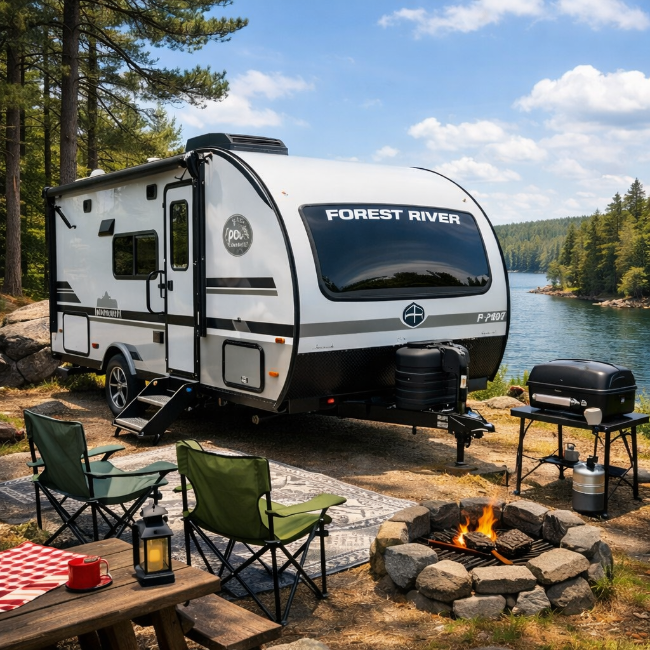 |
Adventure Ready, Lightweight, Easy to TowThe 2026 Forest River R-Pod RP-197 is designed for campers who want a lightweight travel trailer with modern style, efficient use of space, and easier towing confidence. Known for its aerodynamic shape and smart design, the R-Pod appeals to couples and small families looking for flexible travel and campground freedom. This full RV demonstration helps owners and shoppers understand the RP-197 layout, storage, kitchen space, bathroom features, towing-friendly size, campsite setup, and everyday use before the next adventure begins. |
What the R-Pod RP-197 Demo Covers
Smart Interior DesignA look at the sleeping area, kitchen, bathroom, seating, storage, and efficient use of interior space. |
Towable FreedomWhy the R-Pod line is popular for lighter towing, easier handling, road-trip comfort, and campground flexibility. |
Adventure ConvenienceHelpful information on hookups, storage access, controls, appliances, and everyday travel trailer operation. |
Helpful for Similar Lightweight Campers
Even if you do not own this exact 2026 Forest River R-Pod RP-197, this demonstration may still help if you have a similar R-Pod, nearby model year, or another lightweight aerodynamic travel trailer with comparable features and systems.
Ready to Learn More?
Browse inventory, explore more demonstrations, or contact Hilltop Camper & RV today.
Browse Inventory More RV Demonstrations Contact HilltopAI-generated image for illustration only. Actual unit appearance, features, and options may vary. Verify details with Hilltop Camper & RV.